Physiotherapy and rehabilitation
Implement evidence-based blood flow restriction training in your clinic and strengthen your professional practice
How blood flow restriction training strengthens your professional practice
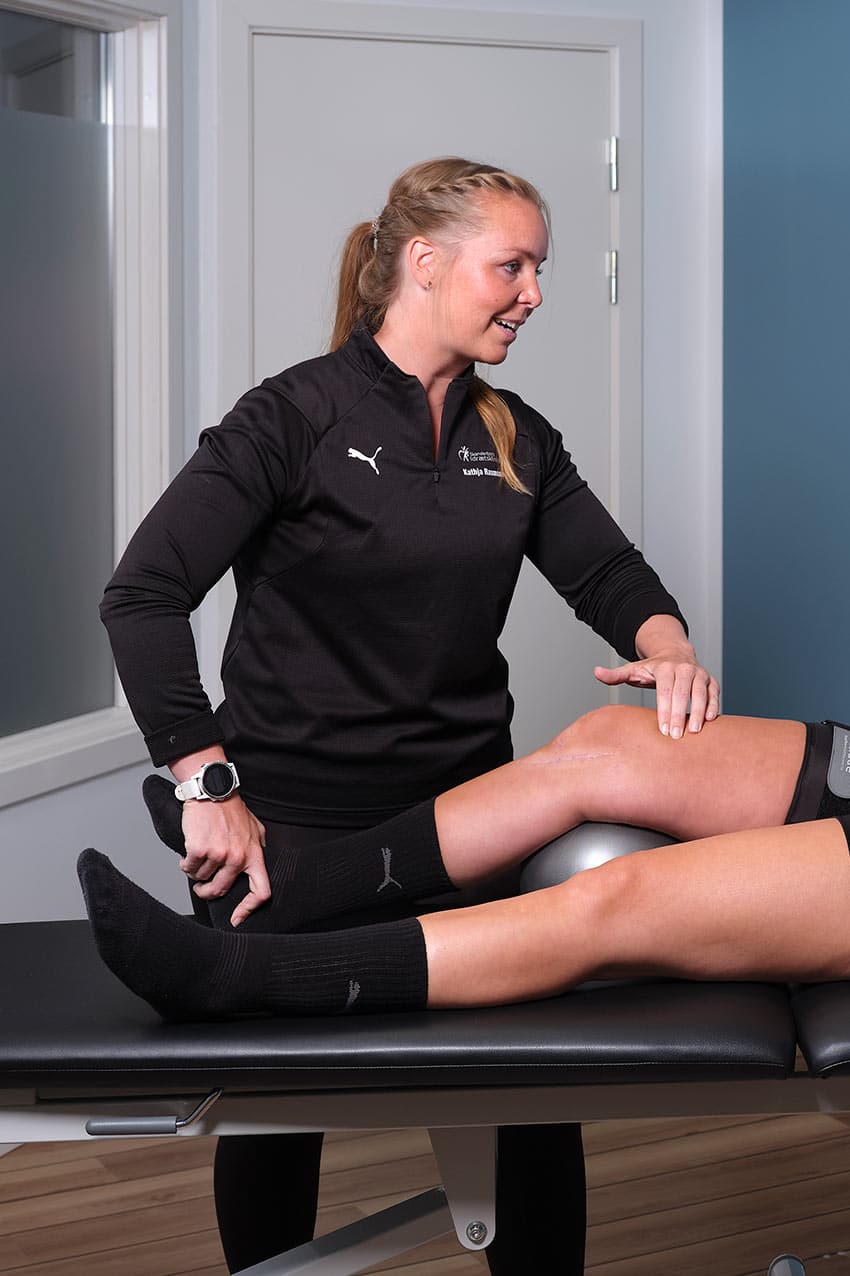
Sportsphysiotherapist
Kathja Rasmussen
Listen how sports physical therapist Kathja Rasmusen use BFR training
A documented tool in rehabilitation and clinical recovery
In recent years, BFR training has secured a central role in modern physiotherapy and rehabilitation. Particularly in early-stage rehabilitation programmes, and for individuals who do not tolerate high mechanical loads, research has clearly demonstrated that occlusion training can make a considerable difference.
BFR training enables physiotherapists, physicians, and other healthcare professionals to increase muscle mass and strength, as well as improve functional capacity in their patients – even when training and physical activity are performed with low external loads.
During BFR training, blood flow to the working muscle is reduced, accelerating muscular fatigue, which is essential for eliciting a training response. Consequently, BFR training facilitates effective strength and hypertrophy adaptations even at very low loads. This approach is particularly appropriate for individuals undergoing rehabilitation or require training without substantial mechanical stress. Examples include athletes with anterior cruciate ligament injuries and patients with osteoarthritis.
BFR training makes it possible to initiate targeted exercise interventions at an earlier stage – without compromising tissue healing or increasing pain and swelling. As a result, individuals may return more rapidly to sport, an active lifestyle, or independent daily living.
BFR training in injury prevention and health promotion
BFR training plays an increasingly significant role in prevention and health promotion – particularly among older adults and physically inactive individuals, for whom traditional high-load resistance training may be challenging and constitute a barrier to participation.
Ageing is naturally associated with a decline in muscle mass and function often referred to as sarcopenia. Low-load training combined with occlusion makes it possible to maintain muscle strength and reduce the risk of functional decline and falls.
The method can be integrated into public injury prevention programmes, training centres, community health centres, and home-based rehabilitation, where accessibility and ease of use are essential.
At Occlude, we have extensive experience in implementing BFR training within these services and settings.
Education in BFR training
We are the leading provider in the Nordic region of courses and workshops in BFR training for clinical application. We deliver teaching and training at clinics, hospitals, public health services, sports clubs, and educational institutions.

Blood flow restriction training is a bridging tool with multiple applications
BFR training should be regarded as a bridging modality in the rehabilitation of individuals whose long-term objective is to return to higher-load resistance training, or as a permanent training alternative for patients who are chronically contraindicated for heavy strength training. BFR training is most often performed using low-intensity resistance exercises, but it may also be combined with walking and/or cycling modalities with scientifically documented effects. The exercises selected for each patient should be determined by the level of intensity the individual can safely tolerate.
Although BFR training remains a relatively new modality for many physiotherapists and healthcare professionals, the body of research underpinning its use is extensive, and its effects are well documented.
BFR training is not harmful or dangerous for healthy individuals; however, it should be introduced gradually, applied in accordance with established guidelines, and preceded by appropriate screening for contraindications.
BFR training enables you to optimize time efficiency while still achieving meaningful outcomes together with your patients.
You can read more about specific patient populations, clinical applications, protocols, and contraindications in our Knowledge Lab.
If you require specific guidance regarding occlusion training, our equipment, or the courses we offer, you are also welcome to contact one of our professional experts.